
Anyone planning a career in museum studies, or anyone living in the 21st century, understands that technology is playing a larger and larger part in our lives. Today, a majority of museum curators and exhibit designers have chosen to cross the threshold into a new digital age, where technology is relied upon to create a more effective learning experience. Prior to the summer of 2019, I admittedly knew very little about the true success behind these adaptations museums were making. Fortunately, I was given an opportunity to speak with exhibit design firms, museum curators, and architects about the realities of technology’s effectiveness in these settings.
It was through Wayne Reckard, from Kubala Washatko Architects who invited me to Wisconsin for a week to meet with museum curators and exhibit design firms that he worked with. One professional I met was Erich Zuern, Executive Producer of Bluewater Studio, based in Grand Rapids, Michigan. Over lunch, Erich explained how museums are constantly experimenting with how visitors learn best. Beginning in the 1970s, curators started altering their exhibits to encourage visitors to fully shape their individual experience. This meant disrupting the flow of the traditional museum exhibit. Allowing people to view objects out of order and not forcing the viewer to go through a designated path was empowering to audiences. Zuern suggested that today’s technology is playing a key role in allowing people the freedom to focus on what interests them.
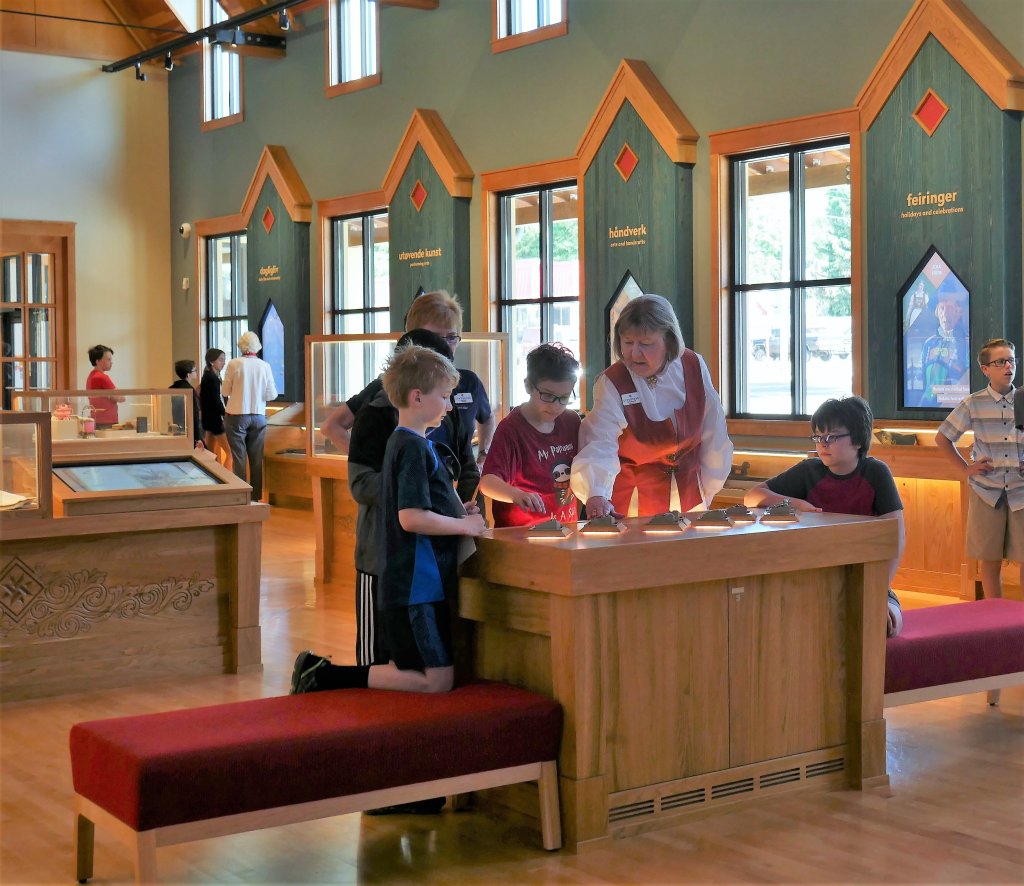
I also visited with the staff of ZebraDog, a Madison, Wisconsin-based exhibit design firm that fully integrates this theory of technology into the environments they build. Amy Beyler, design director, Kathryn Kloehn, senior designer, and Kenneth Casper, architectural exhibit designer went into detail with me about designing the main exhibit room for Livsreise – Norwegian Heritage Center in Stoughton, Wisconsin. Together, they explained the reasoning behind building “heritage kiosks” for the Center. These digital kiosks were built so visitors could conveniently choose how they want to learn about the history of Norwiegan migration to the United States. Beyler pointed out that these kiosks are convenient because they can store large amounts of information in a small space. ZebraDog was also able to incorporate an interactive tabletop that projects the stories of Norweigan immigrants onto a large video screen in the room. A user chooses whether they want to follow the life of a blacksmith, farmer, or shop owner as they make their way to the new world. Just as important, ZebraDog designed this highly interactive activity so that it would be easy to use without assistance. Considering that people with all varying backgrounds in technology visit museums, ZebraDog is making sure their exhibits are not exclusive.
With all the exciting things happening with technology, the curators and exhibit designers I talked with were not shy to also caution about technology’s limits. Zuern was the first to admit that if museums oversaturate their exhibits with technology, there will be no point in going to the museum. Even though museums may start utilizing VR, there is nothing like the sensation of having the physical object in front of you. Most importantly, Zuern added that museums offer a social experience.
Over a conference call with Laurann Gilbertson, the chief curator of Vesterheim: National Norwiegan-American Museum & Heritage Center in Decorah, Iowa I was told that many of their popular exhibits have been around since the 1930s and have gained a sentimental value. Parents still enjoy taking their children to see the large wooden Norweigan boat, just as their parents showed them. For this reason, Gilbertson points out that younger children are not as interested in technology as we suspect. They want their parents to take them to the old exhibits they saw as children and they also want to experience something that is not through a digital screen.
David Whitemyer, Director of Business Development at Luci Creative in Boston echoed the same disposition. Over our conference call, he did not argue technology’s place in the museum, but rather stated that it is mostly a bandwagon phenomenon, with most museums believing it would attract younger visitors. Whitemyer has hope that museums will soon start focusing on their authentic collection and that unnecessary technology will disappear. Things that have local nostalgia, yet also are dimensional and tangible, such as traditional dioramas, prove to be still relevant.
Exhibits do not need to be flashy to be effective. The place with the least amount of technology likely also has the least amount of noise and distraction. Authentic experiences allow for reflection and genuine learning. Museums officials continue to experiment with technology in exhibits and as much as we want it to be, it’s not a science, it’s an art.
 Wayne's Wonder-Room