
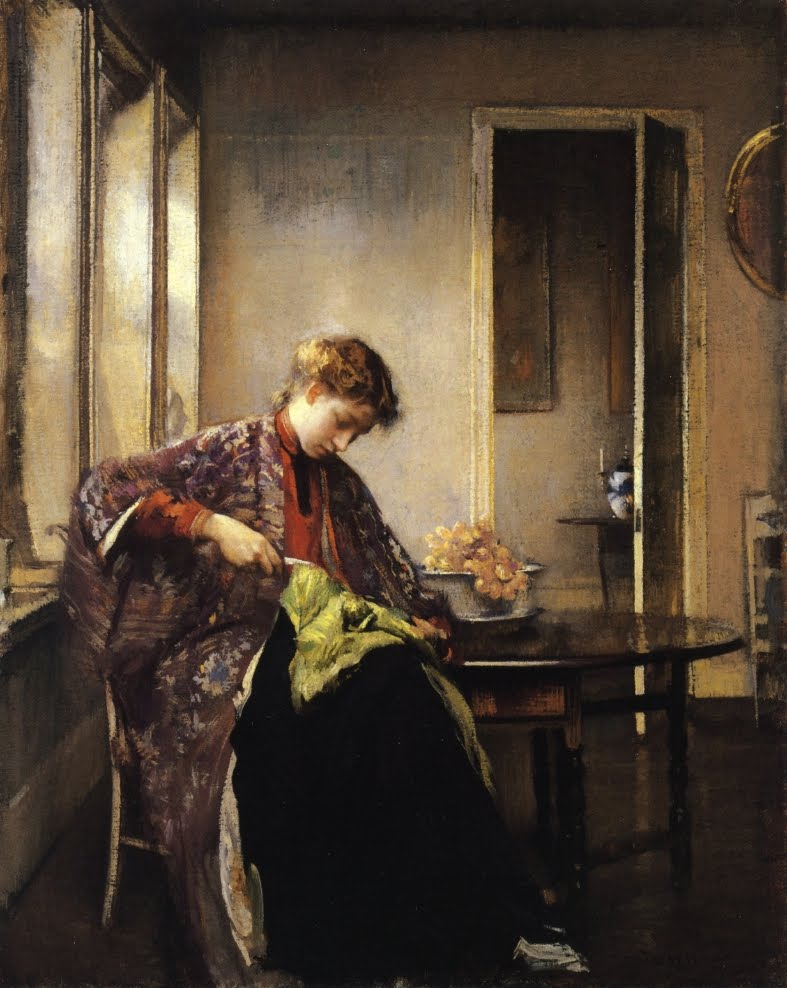
Sitting in between a painting of Egypt and an impressionistic dreamscape of women, there is an inconspicuous painting of a girl mending. A visitor walking through the American and European Art section of Indiana University’s Eskenazi Museum may be more eager to view either one of these works instead of the quiet picture, not as vibrant with color. Although not eye catching, Edmund Charles Tarbell’s A Girl Mending from 1905 reveals a lot with its careful use of natural light, geometric line, and color. Throughout the composition, Tarbell articulates how women’s roles during this time directly placed them in a domestic space.
The typical dimensions of the painting reflects the ordinary nature of the scene. “A Girl Mending” is a rectangular shaped painting, roughly 30 inches high and 20 or so inches wide. It is about the size of the other works it is placed by, in the Eskenazi. Another average characteristic it shares is its material; Tarbell used oil on canvas to create this scene. The oil paint seems partly responsible for the overall dark quality the painting has, even the spots of bright color has dimmed. Viewers can also tell Tarbell applied the paint thinly since dimples can be seen all over the rough canvas, with close inspection.
Tarbell recreates a somewhat wealthy person’s living room, with sleek hardwood floor and delicately placed pictures and vase. These intricacies supplement the dominant focus of the painting. Slightly to the left, at the very forefront of the picture is a young red-haired woman sitting at a round dark hardwood table, that matches the floor’s polished look. Tarbell positions the woman directly in front of three tall windows that occupy the left wall of the room. She is using the natural light pouring from the windows, to mend a cloth. Although it is suggested that there is a natural source of light, the viewer is never shown the outdoors, due to the perspective. As a result, Tarbell creates a completely interior painting. Just behind the woman and to right, the viewer’s eye is led through a doorway and into another room. Only a few pictures on the wall and a white and blue porcelain vase, sitting on a small table, is visible. The composition can be divided into top and bottom halves. The woman and the table absorb almost the entire bottom half, while the top half is empty walls and light. Tarbell intentionally formats the picture this way to draw the viewer’s eye to the girl and to demonstrate the relative emptiness and quietness of the rooms.
It is essential to consider how this interior space is directly impacting the focus of the girl. The very space she inhabits, frames her. In particular, the geometrical lines of the windows and door frame perfectly enclose her head and body. Her face and hands are emphasized through the natural light that reflects off the back of her neck, hair, and right hand. The light also works as a frame because of how it bleeds into the room and reflects off the wall behind her, functioning as a spotlight for the girl. Tarbell is indicating that she is a part of the interior space because of how naturally she conforms to the room’s dimensions through these devices. Color is another tool Tarbell uses to reinforce this story. The room is painted with a subdued goldish tan, that slightly flickers because of the light that bounces off of it. Tarbell uses darker hues of gray and brown to depict the corners and back room where light doesn’t shine through. Although the woman is clothed in a decorated purple floral robe and a coral shirt, she still doesn’t puncture the overall color of the room. Her clothes, including the lime green cloth she is mending, and even her hair, which shares the same goldish tint as the room, blends into the rest of the space. The composition and visual motifs suggest that this anonymous young woman belongs in this room because she is a part of it.
Tarbell continues to expand off of this holistic view of the woman and the interior space. The only movement in the still room is the mender’s arm, bending back and forth. Tarbell paints the girl with streaky, impressionistic lines, only using clear, defined lines for the face and the hand of the girl. The cloth hanging from the girl’s elbow is painted in the least defined way, giving it a smudged look. Tarbell creates a sense of movement from differentiating the lines. This is used as a tool to communicate to the viewer that the girl is in the process of mending. With further examination, the viewer will notice that the girl is entirely defined by her mending. Tarbell casts the front of her face with shadow and since her downcast eyes are focused entirely on the cloth, the viewer is unable to make eye contact with her. This gives the viewer a sense of distance from the actual person. The viewer is supposed to see her as primarily a mender, just as the title of the painting suggests.
Tarbell clearly was not interested in the individual as much as he was interested in the activity itself and its implications. The painting’s description, found on the label, notes that Tarbell often painted these types of pictures, meaning quiet domestic scenes of women doing chores. These types of chores and activities place women directly inside the home, just as the mending links the girl to the room around her. In “A Girl Mending” Tarbell is suggesting that these domestic chores are what define women, just as a worker in the fields is defined by his work. The young woman mending has a sense of modesty because of this. She is looking down at her work and chooses not to confront the viewer with her eyes. Her work instills qualities into her and it becomes a part of her nature.
Edmund Charles Tarbell is able to communicate how a woman can be intrinsically connected to a domestic space, purely through visual techniques in “A Girl Mending”. Tarbell seems to be very intrigued by how activities define a person. With research, one would be able to see if and how Tarbell further explores activities and how gender changes the implications of these actions. Examining Tarbell’s other domestic scenes, as described on the museum label, would also offer intriguing differences in how connected women are to the domestic world around them during this time.
 Wayne's Wonder-Room