On and off since early high school, I have hosted a radio show with my brother. Since embarking on a career in arts management and library science, I have gained an appreciation for how curating music playlists can be an excellent form of outreach, especially if it serves to highlight collections. From a local history research perspective, sharing American roots music encourages curiosity in how folk music, often music from one’s own region, was formative to contemporary music genres. Just as sharing ghost stories serves as a tool in inspiring interest in local folklore, Halloween music also engages listeners’ curiosity. Here is how I use American roots music in that fashion.
Playlist
- Hills of Roan County by the Stanley Brothers (1963)
- Banks of Ohio by Tony Rice (1977)
- Little Omie Wise by Doc Watson (1964)
- Fair-Eyed Ellen by the Blue Sky Boys (1937)
- Asleep in the Briny Deep by the Blue Sky Boys (1938)
- The Unquiet Grave by the Blue Sky Boys (1966)
- Sweet William and Lady Margaret by Jean Ritchie (1956)
- The Wife of Usher’s Well by Hedy West (1965)
- The Ghost Song (The Cruel Ship’s Carpenter) by Peter Bellamy (1969)
- The Bluestone Quarries by Barbara Moncure (1963)
- Death of Goody Nurse by John Allison (1962)
- The Farmer’s Curst Wife by Horton Baker (1962)
- The Devil’s Dream by Hobart Smith (1959)
- When the Grass Grows Over Me by Conway Twitty (1969)
- Old, Old House by George Jones (1970)
- This Haunted House by Loretta Lynn (1964)
- The Silver Ghost by Merle Haggard (1976)
- Delia’s Gone by Waylon Jennings (1969)
- Halloween Is by Tom T. Hall (1979)
Introduction
Curating a music playlist for Halloween can be an amusing challenge. There are realistically very few songs created specifically for Halloween. The late 1950s and early 1960s produced a wave of novelty songs audiences today associate with Halloween, namely the “Monster Mash” and “Purple People Eater”, but they do not literally reference the celebration of Halloween. “Hallowe’en Dance” recorded by the American Symphony Orchestra in 1909 and “Hallowe’en (Jack O’Lantern Rag)” composed by Arthur Manlowe in 1911 offer examples of the earliest occurrences of music which specifically reference Halloween, of which there are few known examples.
Following these conditions, “Halloween” music is sparse. In reality, the genre is more broad than what this metric suggests. Halloween music celebrates the supernatural and macabre – traditionally including ghosts, witches, devils, skeletons, and anything considered “spooky”. In this sense, Halloween music is an extremely expansive genre, making it creatively inspiring to forge October playlists from. The genre of American roots music, particularly music descended from the British Isles, is ripe with music appropriate for Halloween.
Set #1 Murder Ballads
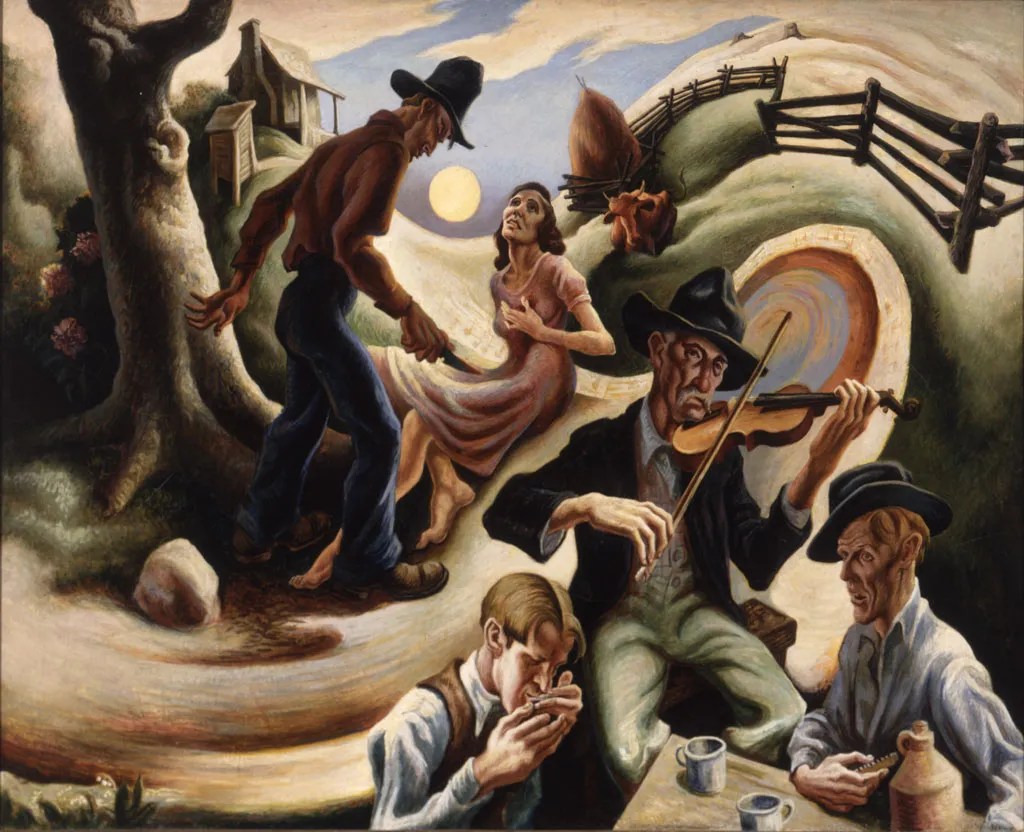
The murder ballad is foundational to the contemporary genres of bluegrass and country-folk music and encourages the listener to contemplate the truly horrific events folk music chooses to preserve. In another sense, they are the original “guilty pleasure horror movie” families indulged in around the fireside. The musical catalogs of traditional bluegrass artists, such as Bill Monroe, Flatt & Scruggs, and the Stanley Brothers, preserve a variety of haunting tales often set in the hills of Appalachia. Our opening track “In the Hills of Roan County” [The Stanley Brothers, 1963] is based on the Willis Maberry poem “Roane County Prisoner” and centers around Maberry’s murder of his brother-in-law in 1884 in East Tennessee. While other tracks are only conceptually based on real events, “Roan County” is unequivocally tied to real murder. “Banks of the Ohio” [Tony Rice, 1977] and “Little Omie Wise” [Doc Watson, 1964] are traditional examples of the tragic ‘jealous lover’ murder ballad, which involves a female victim who is murdered for a variety of reasons, usually involving an unwillingness to marry the murderer. Each ballad stretches to the 19th century and along with “Down in the Willow Garden”, “Pretty Polly”, “Katie Dear”, and “Knoxville Girl” remain popular American murder ballads.
Set #2 Blue Sky Boys
The Blue Sky Boys, consisting of North Carolina natives Earl Bolick and Bill Bolick, were an old-time group who were active from the 1930s to the 1970s. Their recording catalog impressively covers a wide range of American ballads. While the previous three tales conclude with imprisonment, the lesser known murder ballad “Fair Eyed Ellen” [Blue Sky Boys, 1937] hauntingly concludes with zero retribution. Their recording catalog also includes tragic love ballads that conclude in death, but not from murder. “Asleep in the Briny Deep” [Blue Sky Boys, 1938] tells the story of losing loved ones to the sea.
Both subgenres of the ballad often have supernatural roots, which stretch much further back to 18th century England, Scotland, and Ireland. “The Unquiet Grave” [Blue Sky Boys, 1966] is an English folk song and is recorded as Child Ballad 78. It features the folk belief that mourning for twelve months and a day will bring the lover’s dead back to life. Even though Appalachia was abound with European ballads – the isolated mountain villages gave longevity to folk traditions – the Americanized ballads almost always removed their original supernatural endings. The American “Pretty Polly”, colloquially known as “The Gosport Tragedy”, “Cruel Ship’s Carpenter”, or simply “The Ghost Song” in Europe, does not conclude with the murderer being torn apart by the apparition of the victim, but rather with prison.
Set #3 Supernatural Ballads
“Sweet William and Lady Margaret” [Jean Ritchie, 1956] and “The Wife of Usher’s Well” [Hedy West, 1965] are both British Isle ghost stories, which date back to at least the late 18th century. Alan Lomax noted in the liner notes of Eleven American Ballads and Songs [1957] that “The Wife of Usher’s Well” is “one of the great favourites among mountain women, who feel deeply the cruelty of the mother who ‘sent her babes way off yonder over the mountains to study their grammer.’” Stories pertinent to the well-being of young brides and mothers in ballads has inspired a personal curiosity if murder ballads were largely a female storytelling medium in early American music? In the liner notes of Ballads And Folk Songs, Volume II [1948] Burl Ives notes that his mother encouraged the telling of ballads, while his father dismissed them as obscene.
Set #4 Songs of the Devil
Fear of the devil is a popular motif among early American ballads. “The Bluestone Quarries” [Barbara Moncure, 1963] is recorded as representative of the ballads found in the Catskill Mountains. It neatly summarizes how British Isle immigrants brought with them a fear of the supernatural to the New World. “Death of Goody Nurse” [John Allison, 1962] was contemporaneously written by John Allison in the 1960s and was based on the Salem witch trials, which convicted Rebecca Nurse and a number of innocent women of conspiracy with the devil. British Isle immigrants displaced their fear of the supernatural onto women. “The Farmer’s Curst Wife” [Horton Barker, 1962] also recorded as “The Little Devils” is a humorous tale of how women are too hot tempered even for hell. While it has been rationalized as a harrowing tale for strong-willed women, the liner notes of The Folk Songs of Britain Volume 5 notes that “for men it conforms to an old and bitter proverb, ‘there are two places a man wants his wife—in bed, and in the grave.’”
Devils also popularly appear in fiddle instrumentals. “The Devil’s Dream” [Hobart Smith, 1959] is representative of the longevity of British Isle melodies. It likely traces to the Scottish reel, “The De’il Among the Tailors”, meaning “devil” refers to the English board game of the same name. Nonetheless, early American performers of the tune often associated the song with being composed by the Devil. In southwestern Pennsylvania, the melody appears as “Satan’s Nightmare”, removing it from its board game origins.
Set #5 Gothic Country
The longevity of ballads in American folk music was pivotal in the development of country music. The Louvin Brothers’ first commercially released album Tragic Songs of Life [1956] borrowed several British Isle ballads – learned through their family or from earlier country music acts, such as the Callahan Brothers, the Blue Sky Boys, the Delmore Brothers, or the Monroe Brothers. The commercial outbreak of the folk revival movement of the 1960s inspired even more artists to revive traditional ballad music.
“When the Grass Grows Over Me” [Conway Twitty, 1969] invokes images not dissimilar to “The Unquiet Grave”. Lyrics “And as you look down at the cold cold ground I’m sleeping in / Don’t expect to hear me say that I still love you then / Cause I’ll be over you when the grass grows over me” contradicts the folk belief of reviving a lover through mourning, albeit unintentionally on the part of the composer. Haunted houses as analogies for heartbreak or unrequited love are extremely common in popular music. “Old, Old House” [George Jones, 1970] and “This Haunted House” [Loretta Lynn, 1964] are examples of the haunted love metaphor and are reminiscent of the traditional love ballads that often end in death. The prevalence of trains in early country music inspired a multitude of ghost train songs by the likes of Hank Snow, Merle Haggard, and Marty Robbins. “The Silver Ghost” [Merle Haggard, 1976] has particularly good story-telling. Murder ballads have also survived in modern country music through western inspired murder ballads with “The Ballad of Jesse James” being a popular example. Outlaw country artists, such as Willie Nelson, Johnny Cash, and Waylon Jennings seamlessly adapted murder ballads into their repertoire. “Delia’s Gone” [Waylon Jennings, 1969] is a dramatic example of a modern supernatural murder ballad.
Conclusion
There you go – ideas for using American roots music as source material for Halloween music. Admittedly, the insertion of murder ballads into a modern Halloween playlist demonstrates how many of the stories have lost their original meaning. Today’s listeners do not remember the victims who inspired many of the tales. In a concert at Berkeley College in the 1970s, the Blue Sky Boys encountered laughter during the rendition of a murder ballad. The fashion in which audiences connect to ballads is certainly different. However, ballads, especially murder ballads, have always served as entertainment – a guilty pleasure we associate with horror movies today. Halloween is that dedicated time of year we tap into our fascination with the macabre and supernatural. Tom T. Hall’s “Halloween Is” [1979] perfectly encapsulates how Halloween has become the object of that fascination.
Citations
- The Traditional Tune Archive. Creative Commons, 2021, https://tunearch.org/wiki/TTA. Accessed 10 Oct. 2023.
- Mainly Norfolk: English Folk and Other Good Music. Reinhard Zierke, 2023. https://mainlynorfolk.info/folk/. Accessed 10 Oct. 2023.
- Poe, Marshall. “Norm Cohen et al., ‘An American Singing Heritage: Songs from the British-Irish-American Oral Tradition as Recorded in the Early Twentieth Century’ (A-R Editions, 2021).” Folklore. New Books Network, 2022. https://newbooksnetwork.com/category/arts-letters/folklore. Accessed 10 Oct. 2023.
 Wayne's Wonder-Room