Originally posted this short reflection on my LinkedIn in March 2025. Wanted to share it here because I really loved the experience and it feels very seasonal with college football on my mind.
Sports are likely an important part of your life or at least they are to someone close to you. They are in mine. And as an archivist, I value opportunities to share the history of how sports have become a part of our daily lives. With March Madness in full swing, now is a convenient time to bring to life the dichotomy between amateur sports and big business. Earlier this month, I assisted with a class here at the Purdue University Archives and Special Collections (ASC) that used the archives to spotlight how college athletics has struggled with its identity as an amateur sport for over one hundred years.
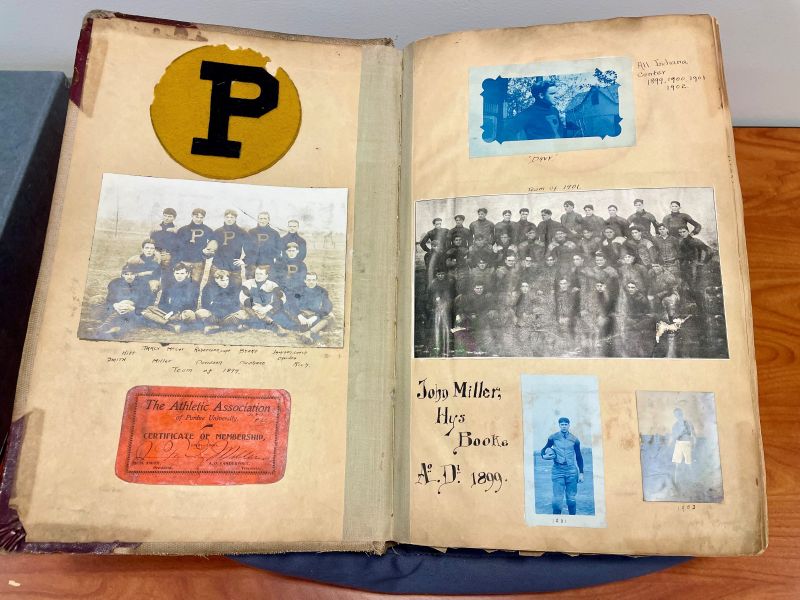
On March 11th and March 13th, I assisted Neal Harmeyer in welcoming Dwaine Jengelley’s Honors 399 Sports and Politics course to ASC. The objective of the class is to teach how sports reflect culture and societal issues. This year’s curriculum included introducing the students to the John F.G. Miller papers at ASC. Miller was a student at Purdue University from 1899 to 1903 and participated in varsity football, basketball, and track. In the 1920s, he was heavily involved with the Intercollegiate Conference, colloquially known as the Western Conference and later known as the Big Ten Conference, through his position as the Chairman of the General Alumni Committee on Athletics. Preserved in his papers are his thoughts on whether college athletes should be considered amateurs or professionals and the consequences it would have on the regulation of college sports. Discussion points that are major topics today, such as paying athletes and how many times athletes should be permitted to transfer schools, appear throughout the papers.
To prepare for the class, I completed research on the papers and set up the classroom for the instruction visit. To assist Neal throughout the two instruction sessions, I introduced the papers to the students, explained how to use ASC for further research, as well as supervised the use of the materials. It was satisfying to chat with the students about the differences between college athletics today and a hundred years ago, such as the average older age of athletes. At the end of the second session, about a dozen students were huddled around Miller’s Purdue scrapbook that documented his time as an athlete and student. Hopefully these were signs that the archival materials brought the story of amateur athletics to life for the students.
John F.G. Miller passed away in 1939, coincidentally the first year of the NCAA Division I Men’s Basketball Tournament. While the tournament has expanded, in more ways than one, we continue to have the same conversations about amateurism and professionalism. I encourage anyone who is interested to check out the John F.G. Miller papers to learn more. There is nothing like seeing the papers yourself.
Thank you to my supervisor, Neal Harmeyer, for the excellent opportunity to chat about sports at the Purdue University Archives and Special Collections!
 Wayne's Wonder-Room